Relationships
Relationship Dynamics: Standing, Expression and Jealousy
In Our Life: Now & Forever, Relationship Standing describes your closeness to Qiu or Tamarack; Expression Elements describe how you behave toward each other. Set each lead separately. Special scenes can offer an increase in Standing, but the developer says you cannot downgrade a relationship in the middle of a Moment.
On this page
Start with the change you actually want
Before changing a setting, decide whether your goal is a different bond or a different way of expressing it. Wanting to be friends rather than having a crush concerns Standing. Wanting a playful, protective or collaborative dynamic concerns Expression. Those are separate decisions; a teasing style is not itself a declaration of romantic interest.
- At the relationship setup for a Step, identify which lead you are setting: Qiu or Tamarack.
- Choose the available Standing that matches the bond you want to portray.
- Set your own Expression Elements for that person. You do not have to use the same pattern for the other lead.
- Read the other character’s settings separately. Your behavior and their behavior need not match.
- When the story resumes, choose the particular dialogue or action that fits your protagonist. The broad dynamic does not replace individual choices.
This is a way to author the relationship you want to read, rather than a prescription to select supposedly optimal answers. GB Patch describes a system where different behaviors can coexist with being liked. There is no supported reason here to treat one expression combination as a universal romance solution.
Standing is mutual; Expression can differ
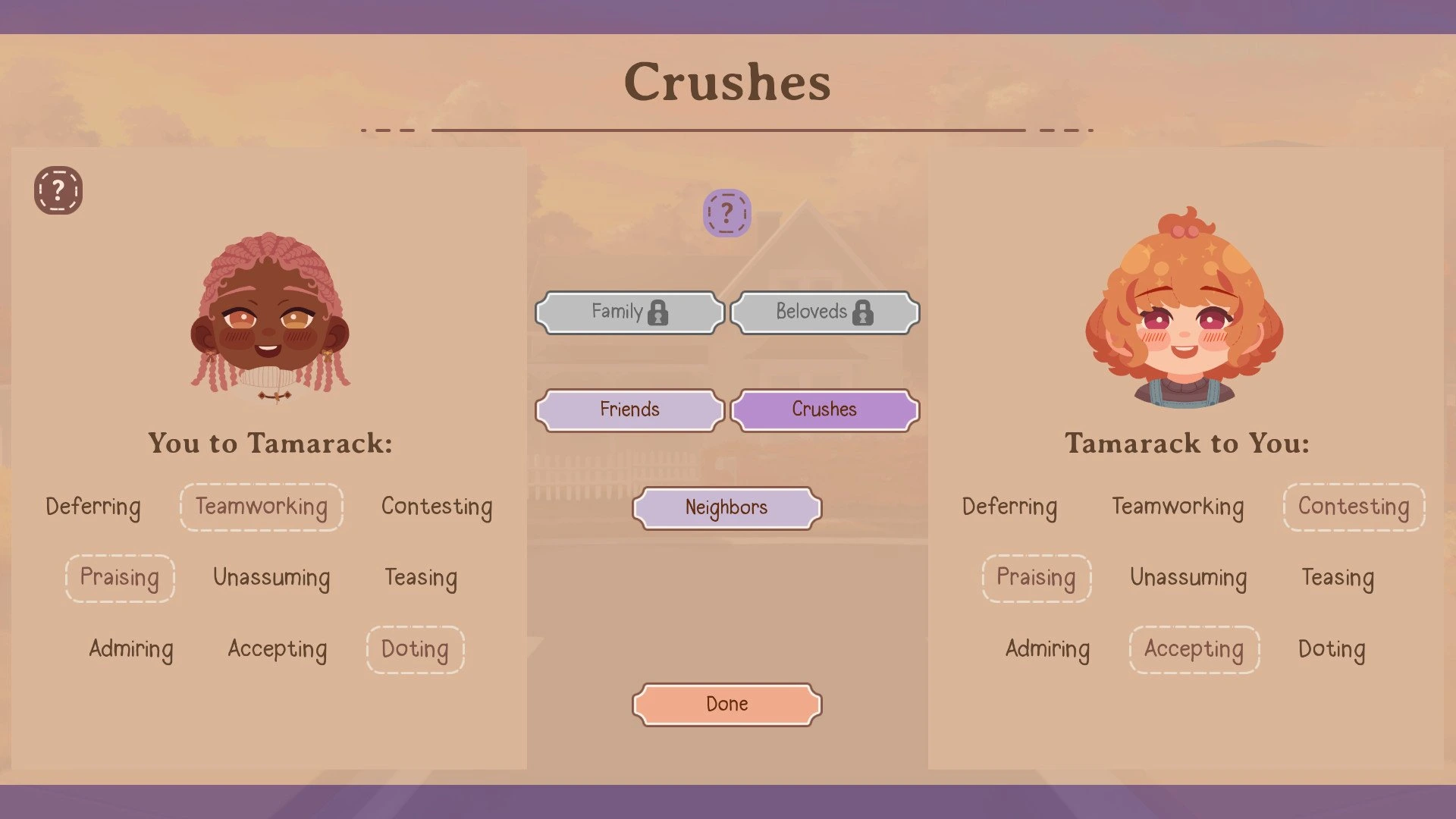
The original design describes Neighbors, Friends and Crushes as the early Standings, available from Step 1. Standing is mutual: choosing Friends represents a bond both characters recognize. It is not a hidden affection total that you must infer from every line of dialogue.
Expression is more specific to each person. A protagonist can collaborate with Tamarack and defer to Qiu, or behave similarly with both. The lead’s settings can differ from yours too. Two people both being Doting can read differently from one being Doting while the other is Idolizing, even though one of the selected labels is the same.
| Axis | What you are choosing |
|---|---|
| Deferring / Teamworking / Contesting | Following, collaborating, or wanting to make decisions. |
| Praising / Easygoing / Teasing | Offering positives, going with the flow, or joking and giving the other person a hard time. |
| Doting / Accepting / Idolizing | Looking after someone, seeing them as an equal, or seeing them as especially impressive. |
Choose these labels for their described behavior, not as good, neutral and bad answers. Contesting does not force every scene to be bold, and a broad style does not remove your ability to respond differently to a particular situation. Treat the three axes as different questions, rather than adding them together into a score.
Changing a relationship during a Moment
A Moment is a story episode, not a general relationship editor. The design allows special cases where Standing changes within a Step. A player’s Demo question describes an offered move from Neighbors to Friends or Friends to Crushes. That does not establish that every Moment contains the same opportunity.
The important limit comes from GB Patch’s January 26, 2025 reply: the story is not built to make a single Moment end a crush or reduce a relationship. If you are looking for Crushes to Friends halfway through a scene, there is no supported downgrade procedure to follow. A disagreement is not evidence that you missed a secret negative-affection option.
For the ordinary early Standings, the original design instead allows selecting a different bond when moving into a new Step. Use that setup to portray a changed relationship over time. This guide does not promise a freely accessible menu in every scene, and it does not give a breakup method for later committed relationships. If the scene offers an increase, decide whether you want that change; if it does not, continue without assuming the build is broken.
Jealous Of, Not Jealous and Jealous Over
The December 2021 design introduces an optional fourth expression axis starting in Step 2, when Standing is something other than Neighbors. This is a dated explanation of the feature, not a claim that every future build uses an identical screen or unlock sequence.
- Jealous Of: envy of something the other person has, such as their circumstances or popularity.
- Not Jealous: skip that optional jealousy element.
- Jealous Over: protectiveness or competition concerning the other person’s attention.
The developer says Qiu and Tamarack naturally default to Not Jealous. To add the optional drama, intentionally customize the relevant settings for them and/or your protagonist. To avoid it, leave the jealousy choice at Not Jealous. Merely spending more Moments with one lead is not a verified automatic jealousy trigger.
Check which person’s expression you are editing. Wanting your protagonist to envy Qiu’s circumstances is different from wanting Qiu to compete for the protagonist’s attention. The names describe different directions of feeling, so switching from one end to the other does not simply make the same jealousy stronger.
Keep older design notes separate from later routes
The original system article also discusses later Standings and a then-undecided poly option. Those passages are development history. Current official material supports poly relationships, so this guide does not repeat the old exclusive-only claim as a current restriction. It also does not turn future adult routes into content already available in the public Demo.
If you are returning for Early Access, identify the build and Step before applying an old screenshot or route tip. The scheduled first release contains Steps 1 and 2; the whole four-Step life story is a broader development plan. A later relationship label mentioned in a design article is not an instruction to unlock it in Step 1.
You have the right setup when…
You can name the lead, the Standing you want, and the behavior each person should express. A missing mid-Moment downgrade is expected, rather than a reason to hunt for a destructive choice. If your next question is about a star beside dialogue, read the choice-history guide; that icon is a different system.
Sources & version
Public Demo guidance. System design dated December 3, 2021; Moment restriction confirmed by the developer January 26, 2025. Early Access is scheduled for November 27, 2026 and has not been tested for this guide.
- Relationship Dynamic System — developer design, December 3, 2021
- Relationship changes during Moments — developer reply, January 26, 2025
- Official game page and current developer replies
- Early Access release announcement — October 19, 2026
Need a source correction? Contact the site. These guides use developer material and do not claim first-hand EA testing.